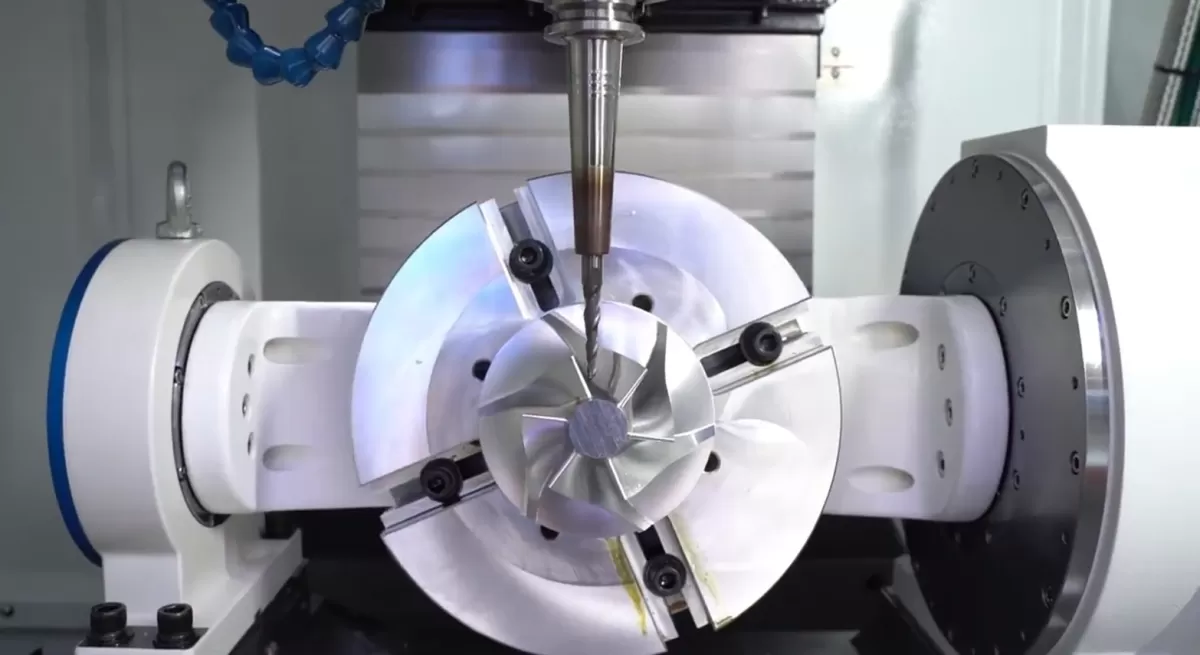
True 5-Axis Simultaneous vs. 3+2 CNC Machining: A Detailed Comparison
Views: 0 Author: Site Editor Publish Time: 2026-06-23 Origin: Site
- 1. 1. The Core Difference: Dynamic Compensation vs. Static Positioning
- 1.1 3+2 Axis Machining (Positional)
- 1.2 Full 5-Axis Simultaneous Machining
- 2. 2. Geometry & Surface Quality: Complex Contours vs. Simple Planes
- 2.1 The Limits of 3+2 Machining
- 2.2 The True 5-Axis Streamline
- 3. 3. The Hidden Economics: Lifecycle Value vs. Upfront Price Tag
- 3.1 Where 3+2 Stealthily Drains Profit:
- 3.2 How Taikan Full 5-Axis Rewrites the Math:
- 4. 4. The Taikan Edge: Built for Real-World Productivity
- 5. 5. FAQ
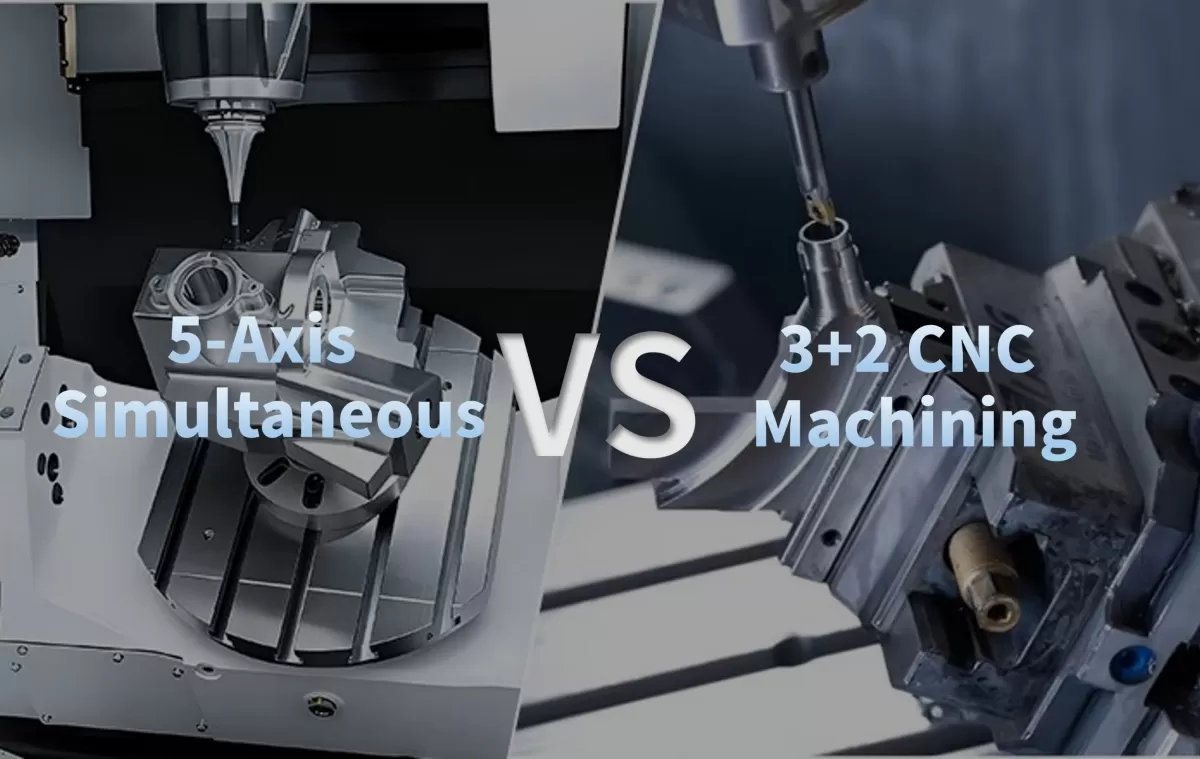
When is a 5-axis machine not truly a 5-axis machine? The answer is simple: When it moves into position using 5 axes, but only cuts using 3.
In high-precision sectors like aerospace, medical devices, automotive, and die/mold manufacturing, the term "5-axis" is often used loosely. This conceptual confusion ends up costing machine shops real money, precious time, and accuracy.
At Taikan Machine, we focus on closing this gap. As a leading, publicly listed CNC machine manufacturer with deep expertise in multi-axis machining, we want to provide a clear, straightforward breakdown of true 5-axis simultaneous technology versus 3+2 axis positioning to help you make the right investment for your shop floor.
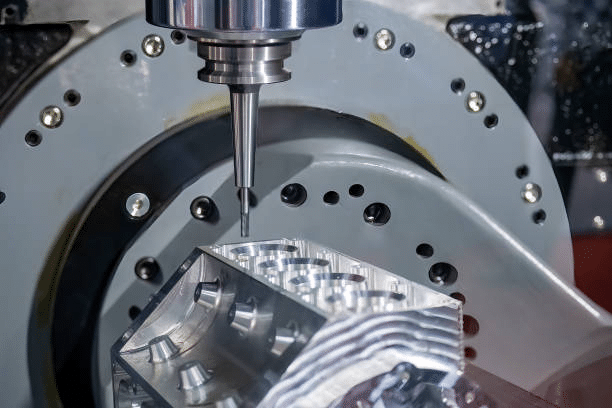
1. The Core Difference: Dynamic Compensation vs. Static Positioning
The fundamental divide between these two methods lies entirely in how the CNC control calculates movement.
3+2 Axis Machining (Positional)
At its core, 3+2 machining is a standard 3-axis operation that borrows two rotational axes solely for orientation.
How it works: The rotary table or spindle tilts the workpiece to a predetermined angle. Once locked into place, all cutting happens strictly along the X, Y, and Z axes.
The drawback: The machining path becomes a series of segmented, stepped approaches. Every time the machine indexes to a new angle, it introduces a new setup. This inherently stacks up positioning errors, requires frequent manual re-touching of work offsets, and adds hidden downtime that cycle-time estimates rarely account for.
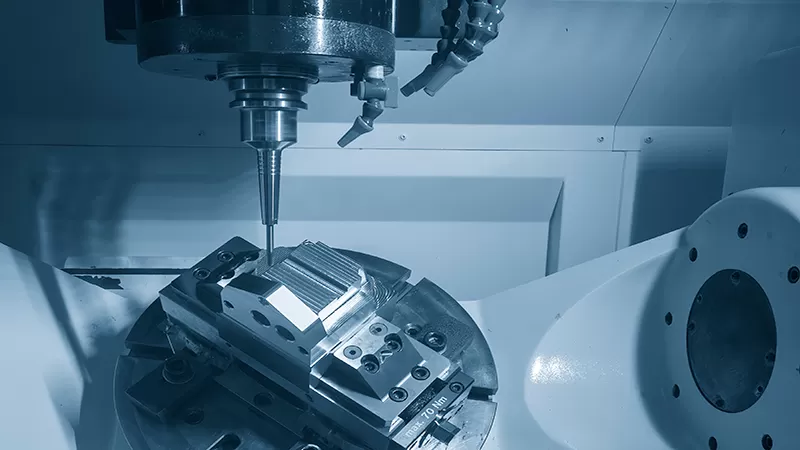
Full 5-Axis Simultaneous Machining
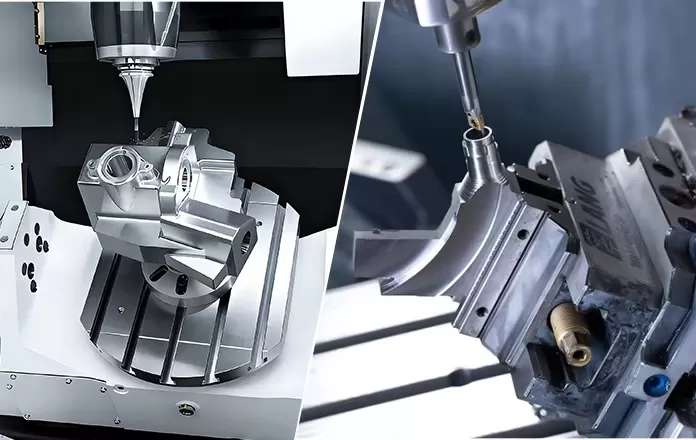
True 5-axis machining keeps all five axes actively interpolating and moving during the cut.
How it works: Every Taikan 5-axis cnc machining center runs on a native CNC architecture featuring RTCP (Rotated Tool Center Point) control.
The advantage: The control continuously calculates the tool tip's spatial offset caused by rotary movements in real time. It automatically compensates for spindle pivot length and table geometry. The tool tip follows the programmed contour flawlessly—even as the workpiece swivels and rotates through complex, compound curves.
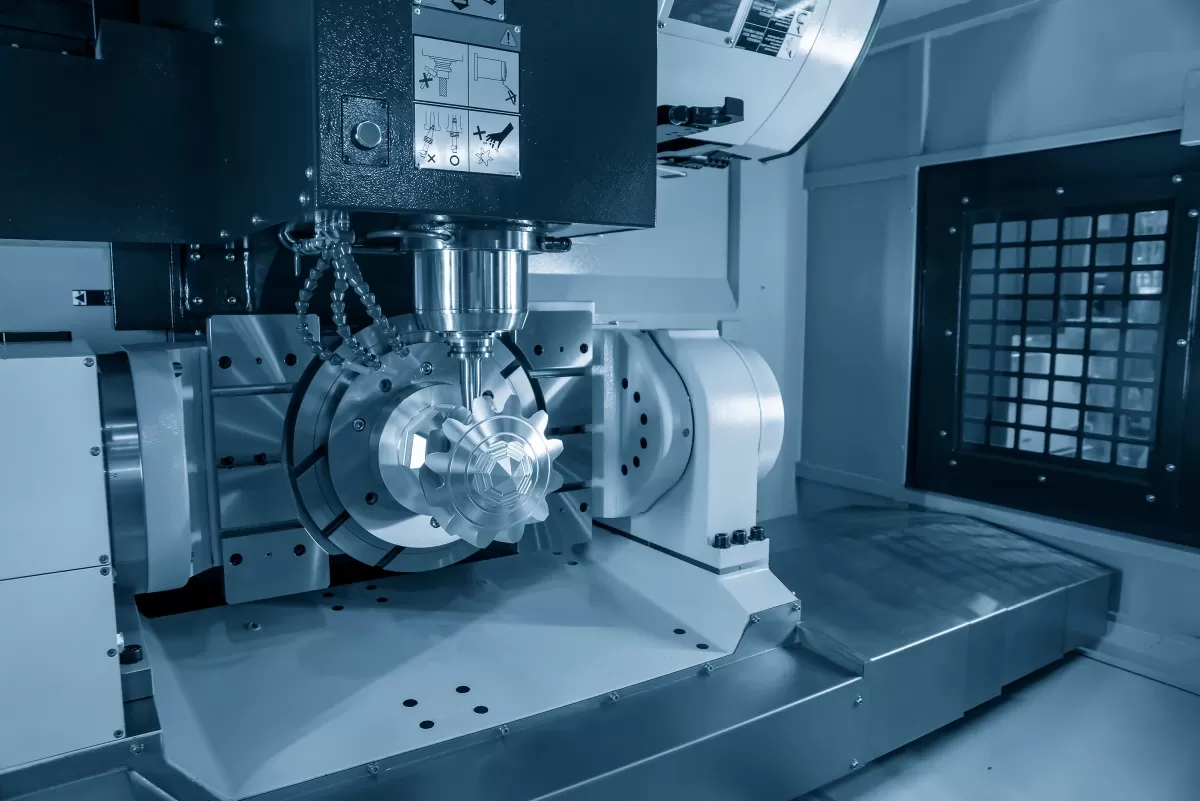
Feature | 3+2 Axis Positioning | True 5-Axis Simultaneous |
Axis Movement | 2 axes position, then lock; 3 axes cut. | All 5 axes move simultaneously during cutting. |
Tool Center Control | Static offsets; manual adjustment required. | Dynamic RTCP compensation in real time. |
Accuracy Level | Prone to tolerance stack-up from indexing. | Holds volumetric accuracy down to $\pm0.005\text{ mm}$. |
Best Suited For | Prismatic parts with flat, angled faces. | Complex, organic geometries and freeform surfaces. |
2. Geometry & Surface Quality: Complex Contours vs. Simple Planes
Your choice between these two technologies directly impacts the surface finish and cycle times of your finished parts.
The Limits of 3+2 Machining
A 3+2 setup excels with prismatic parts—like housing covers or manifold blocks—that require machining on multiple flat faces. You index the part, then drill, tap, or pocket efficiently.
However, when pushed to handle freeform surfaces like impeller blades, orthopedic implants, or aerospace structural components, the logic breaks down:
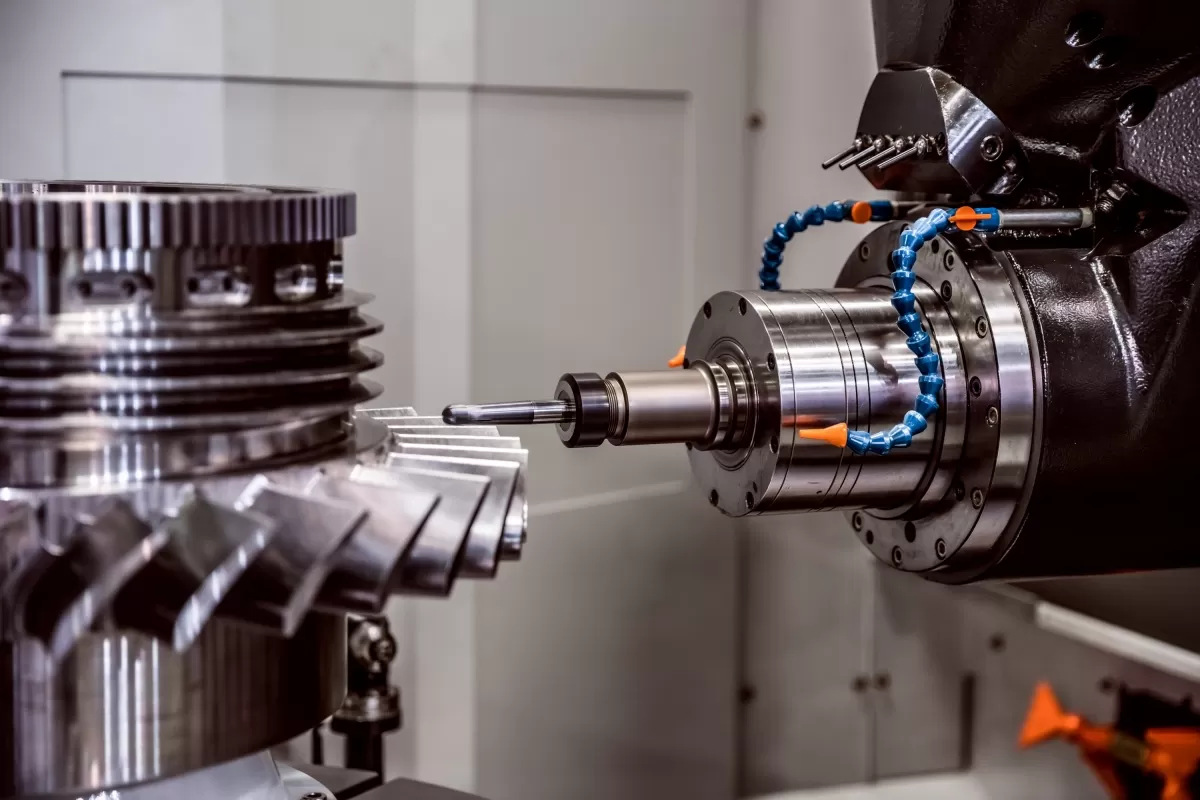
Because it cannot continuously adjust the tool angle relative to a curved surface, the CAM system must approximate the shape using a patchwork of discrete 3-axis toolpaths.
This creates up to 40% toolpath overlap, meaning the machine spends nearly half its time re-cutting the same material.
The result is visible "witness lines" and a rougher surface finish, demanding costly, manual hand-polishing later.
The True 5-Axis Streamline
Taikan’s 5-axis simultaneous platforms eliminate these secondary operations by consolidating multi-step workholding into a single, fluid workflow.
Single-Setup Efficiency: On complex components like electric-vehicle power housings, over ten distinct operations—including continuous contour milling and angular drilling—are completed in one single clamping.
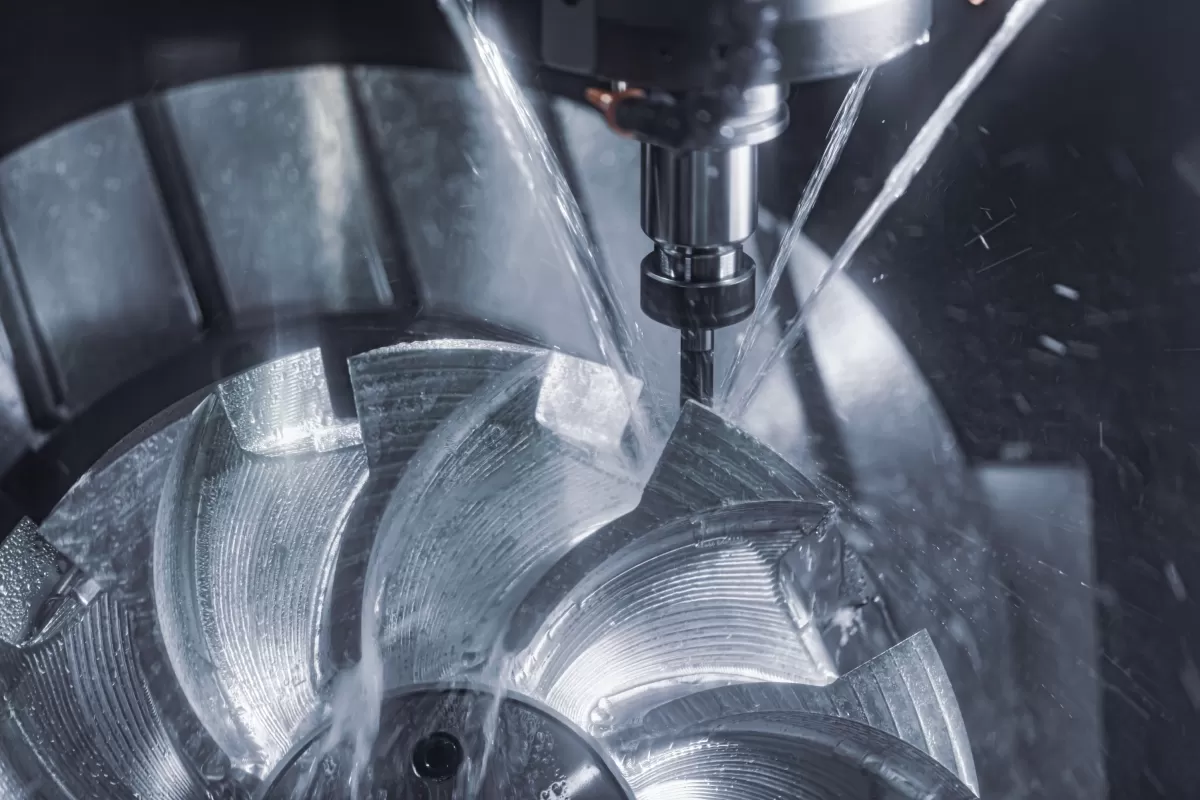
Superior Surface Integrity: The tool orientation adapts dynamically to the surface contours, maintaining a constant chip load and optimal cutting speed. This eliminates blend marks, delivering pristine surface finishes directly off the machine.
Deep Cavity Access: Our long-nose spindle design paired with a high-rigidity cradle rotary table allows shorter, more rigid cutting tools to enter deep cavities effortlessly, improving metal removal rates and tool stability.
3. The Hidden Economics: Lifecycle Value vs. Upfront Price Tag
While a 3+2 machine offers a lower initial sticker price, it often introduces hidden operating expenses that quietly erode your profit margins over time.
Where 3+2 Stealthily Drains Profit:
Fixture Proliferation: Machining a part with five different angled faces often requires multiple dedicated fixtures or complex workholding setups. This increases engineering time, material costs, and ongoing calibration labor.
Accelerated Tool Wear: Because the tool axis is locked in a 3+2 setup, shops are forced to use long-reach, extended-gauge end mills to access deep features without colliding. These longer tools are highly prone to deflection, vibration, and premature failure.
Operator Quality Risk: Every manual repositioning and fixture adjustment introduces human error. Scrap rates inevitably climb when relying on manual operator intervention rather than automated machine kinematics.
How Taikan Full 5-Axis Rewrites the Math:
Taikan 5-axis simultaneous machines are engineered to drive down the total cost per part, maximizing your long-term return on investment:
Minimized Idle Time: Equipped with a fast tool magazine boasting a 2-second chip-to-chip change time, our machines ensure the spindle keeps running with minimal interruption.
Simplified Workholding: Because RTCP handles dynamic coordinate transformations automatically, operators do not need to center the workpiece perfectly on the trunnion centerline. This slashes setup times from hours to minutes.
Longer Tool Life: By tilting the workpiece dynamically, the machine allows the use of shorter, rigid cutting tools. This drastically reduces tool deflection, extends tool life, and lowers your monthly consumables spend.
4. The Taikan Edge: Built for Real-World Productivity
At Taikan Machine, we do not simply retrofit rotary tables onto standard 3-axis platforms. Our 5-axis simultaneous machining centers are designed from the ground up with an integrated native CNC architecture. The kinematic models, servo loops, and RTCP algorithms are perfectly synchronized to execute flawless spatial curve interpolation without stuttering or micro-deviations.
As a publicly listed company with a robust global support infrastructure, taikan delivers production-hardened 5-axis technology that is highly accessible to small and medium enterprises, not just tier-one manufacturing giants.
As part designs evolve toward thinner walls, organic structures, and tighter tolerances, true 5-axis synchronization is no longer a luxury—it is the baseline for staying competitive. Look beyond the initial purchase price and evaluate the total lifecycle value. When all five axes are alive and synchronized, complexity stops being a challenge and becomes your unfair advantage.
5. FAQ
1) What is the fundamental difference between true 5-axis simultaneous machining and 3+2 axis machining?
3+2 locks the rotary axes in position and cuts with only X, Y, and Z, building the toolpath from segmented, static steps. Taikan's full 5-axis simultaneous machines keep all five axes coordinated during the cut, using RTCP to dynamically compensate the tool tip for one continuous, flowing motion.
2) Does 3+2 axis machining still have a valid place in a modern shop?
Yes—it remains efficient for prismatic parts where features are perpendicular to a few angled faces. The moment your geometry includes freeform surfaces or deep cavities, however, a 3 axis machining center operating in a 3+2 configuration hits a kinematic ceiling that genuine 5-axis simultaneous technology is built to break through.
3) What is RTCP?
RTCP (Rotated Tool Center Point) is a real-time control algorithm that automatically compensates for tool tip displacement every time a rotary axis moves. That dynamic correction is what lets a Taikan 5-axis machine hold volumetric accuracy in the ±0.005 mm domain, a tolerance band static 3+2 positioning cannot reliably sustain across multiple angular setups.
4) Why does full 5-axis produce better surface finishes on complex contours?
3+2 forces the CAM system to approximate a freeform surface with fixed-angle patches, often causing up to 40% toolpath overlap and surface roughness stuck around Ra 6.3 µm. Full 5-axis keeps the tool normal to the surface in one uninterrupted sweep, delivering far higher surface integrity and frequently eliminating manual blending.
5) Isn’t a full 5-axis machine much more expensive? How do I justify the investment?
The upfront price is higher, but 3+2 hides substantial costs in dedicated fixturing, faster tool wear from long-gauge-length cutters, and repeated manual setups. By collapsing multiple operations into one clamping with faster chip-to-chip times, a Taikan 5-axis simultaneous machine typically drives a lower total cost per part over its lifecycle.
6) What applications gain the most from a Taikan full 5-axis simultaneous machine?
Any part that currently demands multiple setups, contour blending, or deep-cavity access—aerospace impellers, EV power housings, medical implants, and precision mold cavities lead the list. If fixture complexity and hand-finishing labor are squeezing your margin, you have already entered full 5-axis territory.