Complex turned parts rarely stay within simple turning operations. A shaft, connector, valve body, motor component, or precision sleeve may begin as a turning job, but the drawing often includes side holes, milled flats, slots, grooves, cross-drilled features, or threaded surfaces that require more than a standard lathe. If these operations are moved to another machine, the factory must manage extra clamping, more work-in-process handling, and a higher risk of datum shift.
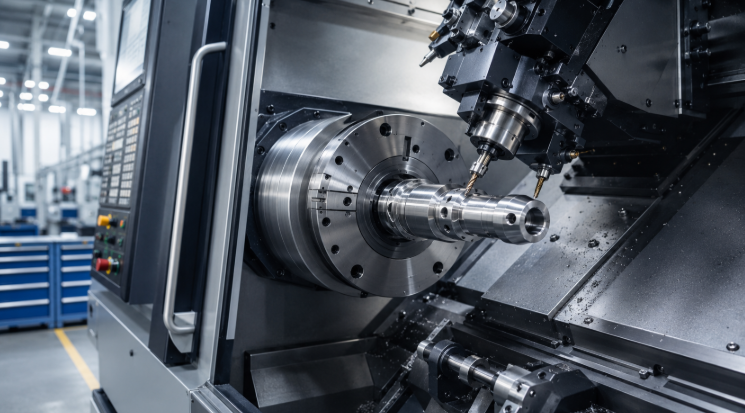
A CNC turning-milling compound lathe is a CNC machine tool that combines turning with milling, drilling, tapping, and indexing functions so that more features of a complex part can be completed in one setup.
For overseas factories comparing a china cnc lathe machine, the key question is not only spindle speed or chuck size. The more practical question is whether the machine can reduce secondary setup while keeping turning accuracy, milling access, tool capacity, and process stability under control.
Why Complex Parts Often Need More Than Standard Turning
A standard CNC lathe is effective for outside diameter turning, inside diameter boring, facing, grooving, and threading. However, many modern parts include off-center features or side machining requirements. Once a workpiece must be removed from the lathe and transferred to a machining center, the process becomes longer and harder to control.
Secondary setup may create several production risks:
Datum shift between turning, milling, drilling, and inspection operations.
Longer cycle time caused by loading, unloading, re-clamping, and part transfer.
Higher fixture cost when each operation needs a separate clamping method.
More operator judgment during alignment and workpiece positioning.
Inconsistent batch quality when small setup differences accumulate over repeated parts.
This is why many factories consider turning-milling compound equipment when a part is still mainly rotational, but no longer simple enough for turning alone.
How Y-Axis Machining Reduces Secondary Setup
Y-axis machining adds off-center cutting capability to a turning process. Instead of only cutting along the spindle centerline, the tool can move away from the centerline to machine side holes, flats, slots, and milled surfaces. When combined with C-axis indexing and live tooling, it allows more complete machining in one clamping.
Y-axis capability does not automatically replace every machining center operation. It is most useful when the part is rotational in nature but includes side features that would otherwise require a second machine. For example, a valve component may need turning on the outside diameter, drilling on the face, and milled flats or cross holes on the side. Completing these steps in one setup can improve datum consistency and reduce handling time.
Y-axis turning-milling is especially helpful when the part requires:
Off-center holes, cross holes, or angled drilling features.
Milled flats, slots, pockets, or wrench surfaces on a round part.
Turning and milling operations that must reference the same datum.
Reduced transfer between a lathe and a machining center.
Better consistency in small and medium batch complex part production.
Standard CNC Lathe vs Turning-Milling Compound Lathe
The decision should be based on the part drawing, not the machine name. A standard lathe may be enough for simple shaft and disc parts. A turning-milling compound lathe becomes more practical when side features, live tool operations, or one-clamping consistency are important.
| Comparison Factor | Standard CNC Lathe | Turning-Milling Compound Lathe |
| Main process | Turning, boring, facing, grooving, threading | Turning, milling, drilling, tapping, indexing |
| Side feature capability | Limited without additional setup | Stronger when equipped with live tooling and indexing |
| Secondary setup | Often required for milled or off-center features | Reduced when more features are completed in one clamping |
| Best-fit parts | Simple shafts, bushings, rings, and discs | Complex rotational parts with holes, flats, slots, and milled features |
| Process control | Depends more on transfer accuracy between machines | Improves datum consistency by keeping operations on one machine |
Where a CNC Lathe and Milling Machine Fits in Production
A cnc lathe and milling machine is useful when a factory wants to shorten the process route for parts that combine rotational geometry with local milling features. This is common in hydraulic components, valve parts, precision shafts, motor components, connectors, automation parts, and metal fittings.
 Compound Lathe.png "L-M Series CNC Horizontal Turning(Milling) Compound Lathe.png")
Taikan’s L-M Series is positioned as a high-precision CNC horizontal turning-milling compound lathe. The lineup includes L-25M, L-35M, L-35MP, L-45M, and L-45MP models. Its listed configuration includes BMT45 or BMT55 power turret options, hydraulic sleeve tailstock with live center structure, mechanical spindle as standard, motorized spindle as optional, C-axis indexing, hydraulic brake assist, a 30° inclined bed, and linear guide feed axes.
The L-M Series specification range also provides useful selection references: chuck sizes include 6-inch, 8-inch, and 10-inch options; maximum swing diameter on bed reaches Ø520mm or Ø600mm depending on model; maximum machining diameter covers shaft and disc ranges from Ø200/Ø250mm to Ø380/Ø450mm; maximum machining length is listed at 400mm or 900mm; and maximum spindle speed ranges from 2,500r/min to 5,300r/min by model.
Key Parameters Buyers Should Check Before Choosing
Turning-milling compound selection should start with the part drawing and process route. Buyers should not compare only the machine envelope. The more important task is to confirm whether the machine can complete the required turning, milling, drilling, and indexing steps without creating new bottlenecks.
| Parameter | Why It Matters | Buyer Focus |
| Chuck size | Determines the practical workpiece holding range. | Match chuck size with raw material diameter and fixture method. |
| Maximum machining diameter | Affects whether shaft and disc parts fit the machine. | Check both shaft and disc machining limits. |
| Machining length | Long shafts need enough Z-axis working range and support. | Confirm part length, tool clearance, and tailstock requirement. |
| Power turret | Supports live tooling and compound operations. | Review turret type, tool stations, and required live tools. |
| C-axis indexing | Enables controlled angular positioning for side features. | Check indexing accuracy and brake support for milling loads. |
| Machine acceptance | Accuracy and repeatability affect batch consistency. | Use recognized testing references where applicable. |
For buyers, this makes acceptance testing and repeatability verification more than a formality, especially when compound machining affects multiple features on one part.
How to Decide Whether One-Setup Machining Is Worth It
A compound lathe should not be purchased only because it has more functions. It should be chosen when those functions remove real process waste. If the part still needs complex 3-axis milling after turning, a machining center may remain necessary. But if most secondary features can be handled by live tooling, C-axis indexing, or Y-axis machining, the production route may become shorter and more stable.
Before confirming a model, buyers should review:
Which features are currently completed on the lathe and which require another machine.
Whether side holes, slots, flats, or milled features can be finished in one clamping.
How much accuracy is lost during transfer between machines.
Whether the production volume justifies a more capable compound machine.
Whether operators and programmers can support turning-milling process planning.
Taikan’s broader cnc lathes and centers portfolio includes CNC lathes, vertical machining centers, horizontal machining centers, 5-axis machining centers, drilling and milling centers, gantry machining centers, profile machining centers, CNC Swiss-type automatic lathes, and other equipment for high-end intelligent manufacturing.
 Compound Lathe1.png "L-M Series CNC Horizontal Turning(Milling) Compound Lathe.png")
For factories comparing long-term suppliers, Taikan’s homepage presents 4 modern manufacturing bases, 3,000+ employees, 785,300+ square meters of factory area, 700+ core patents, 9 CNC machine tool series, and a sales and service network covering 50+ countries and regions.
Conclusion
A CNC turning-milling compound lathe is most valuable when it removes real secondary setup from complex rotational parts. Buyers should compare part geometry, live tooling needs, C-axis or Y-axis requirements, chuck size, machining length, turret capability, and acceptance testing before choosing a machine.
FAQ
What is a CNC turning-milling compound lathe?
It is a CNC lathe that combines turning with additional operations such as milling, drilling, tapping, and indexing so that more features can be completed in one setup.
Why does Y-axis machining reduce secondary setup?
Y-axis movement allows off-center machining, such as side holes, flats, slots, and local milled features. This can reduce the need to transfer a part from a lathe to a separate machining center.
Can a CNC turning-milling compound lathe replace a machining center?
Sometimes, but not always. It can replace secondary machining for many rotational parts with side features, but complex prismatic parts may still require a machining center.
What parts are suitable for a CNC lathe and milling machine?
Suitable parts include valve components, hydraulic parts, precision shafts, motor components, connectors, automation components, and other rotational metal parts with milled or off-center features.
What should overseas buyers check before ordering?
Buyers should check chuck size, machining diameter, machining length, spindle configuration, turret type, live tooling needs, C-axis or Y-axis requirements, accuracy verification, spare parts, and after-sales support.
Wayne Zhao
Chief Technical Expert, Taikan Machine
A CNC expert with 10+ years of experience in control systems and machining.
Formerly with Siemens and FANUC, Wayne specializes in system commissioning, 5-axis programming, and integrated machining applications. He is dedicated to transforming technical expertise into actionable industry insights.

 Español
  português
  русский
  العربية
  Türkçe
  français
  Deutsch
  italiano
  ไทย
ไทย  tiếng việt
  Polska
  Malay
Malay  हिंदी
हिंदी  Indonesia
  ಕನ್ನಡ
ಕನ್ನಡ 

 Vertical Machining Center Drilling and Milling Machining Center Profile Machining Center Horizontal Machining Center 5-Axis Machining Center Gantry Machining Center CNC Lathe CNC Swiss-Type Automatic LatheS series Standard Edition with 3-Axis Linear Guide Rails H Series Advanced Edition with 3-Axis Linear Guide Rails M Series Excellent Rigidity T-V Series Light Cutting W Series Hub Machining L Series Two Rails and One Hard Rail T Series 3-Axis Hard Rail HDT Series High Precision Vertical Machining CenterB Series Drilling & Milling Machining Center S Series Drilling & Milling Machining Center SE Series Drilling & Milling Machining CenterT Series Moving Column Type & BT30 (Tilt-Disc Tool Magazine) V Series Moving Column Type & BT40 (Tilt-Disc Tool Magazine)HT-H11 Horizontal Machining Center HHQ5 High Rigidity Horizontal Machining Center HDH-63 Horizontal Machining Center HDH-100S Horizontal Machining CenterT-U Series 5-Axis Tapping Machining Center V-U Series Vertical 5-Axis Machining Center FH Series 5-Axis Milling and Turning Machining Center CX700-2000 Seven-axis Five-simultaneous Milling And Turning Machining CenterG-V Series 3-Axis Linear Guides G-VU Series 5-Axis Gantry Machining Center G-BU Series Bridge 5-Axis Gantry Machining Center