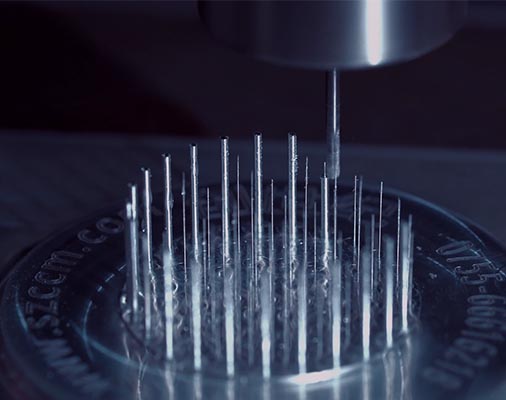
A Swiss-type lathe is a CNC turning machine designed for the high-precision machining of small, slender, and complex parts. It uses a sliding headstock and guide bushing to keep the workpiece supported close to the cutting point.
This design makes Swiss-type CNC machining ideal for small-diameter, long, and complex precision-turned parts. Compared with a conventional CNC lathe, a Swiss-type CNC lathe offers a different approach to supporting and moving the workpiece. The result is a stable machining process that is well suited to precision production.
For manufacturers working with small and complex components, understanding what a Swiss-type lathe is, how it works, and when to use it helps them choose the right CNC turning solution.
What Is a Swiss-Type Lathe?
A Swiss-type lathe, also known as a Swiss-type CNC lathe or sliding-headstock lathe, is a CNC turning machine in which the headstock moves along the longitudinal axis while the bar stock is supported close to the cutting area.
The key difference is the position of the cutting support.
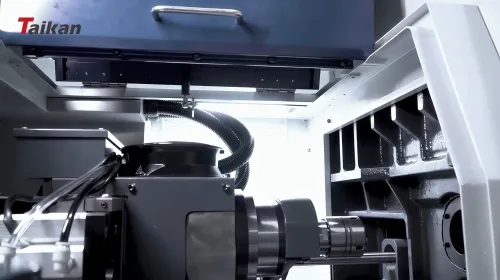
On a conventional CNC lathe, the workpiece is generally held by a chuck or collet, and the cutting tool moves along the workpiece. In Swiss-type machining, the bar material passes through a guide bushing. The guide bushing supports the material close to the cutting tool, while the headstock moves to control the cutting position.
This configuration reduces unsupported material length during machining. As a result, it is particularly effective for small-diameter and slender workpieces where rigidity and dimensional stability are important.
The guide bushing is one of the defining elements of Swiss-type machining. By keeping the cutting area close to the support point, the machine can maintain stable cutting conditions even when machining long, slender components.
How Does a Swiss-Type CNC Lathe Work?
A Swiss-type CNC lathe works by controlling movement between the workpiece, headstock, guide bushing, and cutting tools.
First, the bar material passes through the guide bushing. The guide bushing supports the material near the cutting zone. The headstock then moves along the longitudinal axis, bringing the required section of the bar into the machining area.
The cutting tool removes material while the workpiece remains supported close to the cutting point.
This is fundamentally different from simply holding a long bar at one end. The shorter unsupported section helps improve machining stability and control during turning.
Modern Swiss-type CNC machines can also combine multiple machining operations in one setup, depending on the machine configuration. This can reduce the need for repeated workpiece handling and help manufacturers maintain consistent machining conditions throughout production.
DMG MORI, for example, describes Swiss-type technology that uses a guide bushing and sliding-headstock movement for long and complex turned components.
Swiss-Type Lathe vs. Conventional CNC Lathe
The biggest difference between a Swiss-type lathe and a conventional CNC lathe is how the workpiece is supported during machining.
A conventional CNC lathe normally holds the workpiece with a chuck or collet. The cutting tool then moves along the workpiece to perform turning operations.
A Swiss-type CNC lathe uses a guide bushing to support the bar close to the cutting area. The sliding headstock moves the material through the machining zone.
This difference becomes important when machining small and slender parts.
Feature | Swiss-Type CNC Lathe | Conventional CNC Lathe |
Workpiece support | Guide bushing close to cutting point | Chuck or collet |
Headstock | Sliding headstock | Fixed headstock in typical configuration |
Main strength | Small, slender, precision parts | Broad range of turned components |
Typical application | Precision small-part production | General CNC turning |
Machining focus | Stable precision turning | Flexible turning operations |
Neither machine is universally better. The right choice depends on the part geometry, material, machining requirements, and production volume.
For small and slender precision components, however, a Swiss-type CNC lathe can provide a clear process advantage.
Why Use a Swiss-Type CNC Lathe?
Stable Machining of Small and Slender Parts
One of the main advantages of Swiss-type machining is workpiece support.
Small-diameter and long parts can be difficult to machine on a conventional turning machine. The longer the unsupported section becomes, the more important workpiece stability becomes.
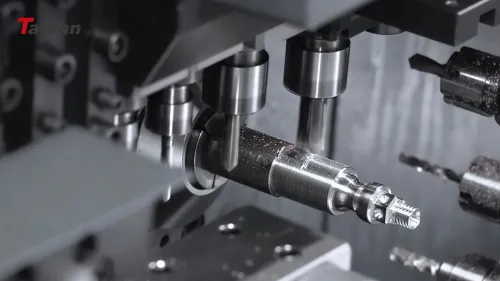
A Swiss-type lathe keeps the cutting area close to the guide bushing. This creates a more stable cutting condition and helps control workpiece movement during machining.
For precision-turned parts with a high length-to-diameter ratio, this design is particularly valuable.
High Precision for Small Components
A Swiss-type CNC lathe is designed for precision turning.
The guide bushing supports the material close to the cutting point. The sliding headstock controls the position of the workpiece along the longitudinal axis.
This machining concept is well suited to small components that require consistent dimensions and controlled cutting conditions.
For manufacturers producing precision components in large quantities, process stability is just as important as the ability to machine a single part accurately.
Efficient Production
Production efficiency is another important advantage of Swiss-type CNC machining.
Depending on the machine configuration, a cnc swiss type automatic lathe can perform multiple machining operations in one setup.
This can reduce the need for additional workholding and repeated part handling. It can also help maintain consistent machining conditions from one operation to the next.
For high-volume precision turning, these benefits can improve overall production efficiency.
Consistent Part Quality
A successful production process must deliver consistent results over many workpieces.
The guide-bushing design of a Swiss-type lathe provides stable support during machining. Combined with CNC control, this creates a repeatable machining process for precision turned components.
This makes Swiss-type CNC machines well suited to production environments where dimensional consistency and process stability are critical.
What Parts Can a Swiss-Type Lathe Machine?
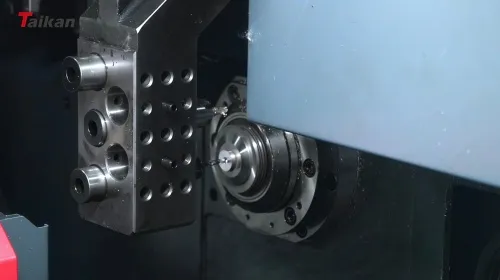
A Swiss-type lathe is mainly used for small and precision turned parts.
Typical components include:
The technology is widely associated with industries that require small, precise components.
These include:
The exact suitability of a Swiss-type CNC lathe depends on the part design and production requirements.
Important factors include workpiece geometry, material, machining length, required tolerances, machining operations, and production volume.
The best machine is therefore not selected by part size alone. It should be selected according to the complete machining process.
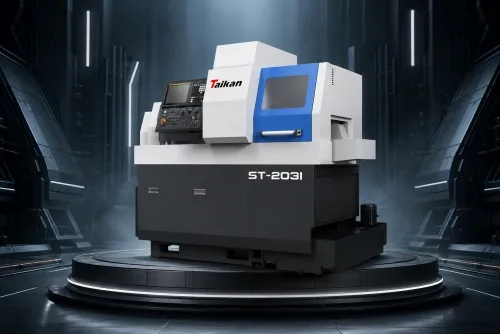
Taikan Machine Swiss-Type CNC Lathe
As a CNC machine tool manufacturer serving customers worldwide, Taikan Machine develops turning solutions for modern precision manufacturing.
Item | Unit | ST-203 Single spindle, 3 axes | ST-263 Single spindle, 3 axes | ST-323 Single spindle, 3 axes |
Max. machining diameter | mm | Ø 20 | Ø 26 | Ø 32 |
Max. machining length | mm | Max. 240 | Max. 240 | Max. 240 |
Front drilling diameter | mm | Max. Ø 10 | Max. Ø 10 | Max. Ø 13 |
Front thread machining | mm | Max.M8 | Max.M8 | Max.M8 |
Supports customized processing solutions. |
These specifications are designed around the needs of precision turning. The machine provides a focused solution for manufacturers processing small and precision components that require stable CNC machining.
Looking for a Swiss-type CNC lathe for your production needs? Contact Taikan Machine to discuss your machining requirements.
Frequently Asked Questions
What is a Swiss-type lathe?
A Swiss-type lathe is a CNC turning machine that uses a sliding headstock and guide bushing to support the workpiece close to the cutting point. It is mainly used for small, slender, and precision-turned parts.
What is a Swiss-type CNC lathe used for?
A Swiss-type CNC lathe is used for machining small and precise components, especially parts with long lengths, small diameters, or complex turning features.
What is the difference between a Swiss-type lathe and a CNC lathe?
The main difference is workpiece support. A conventional CNC lathe typically holds the workpiece in a chuck or collet. A Swiss-type lathe uses a guide bushing and sliding headstock to keep the cutting area close to the workpiece support.
Is Swiss-type machining suitable for high-volume production?
Yes. Swiss-type CNC machining is well suited to precision production because it provides stable workpiece support and can combine multiple machining operations depending on the machine configuration.
What materials can be machined on a Swiss-type lathe?
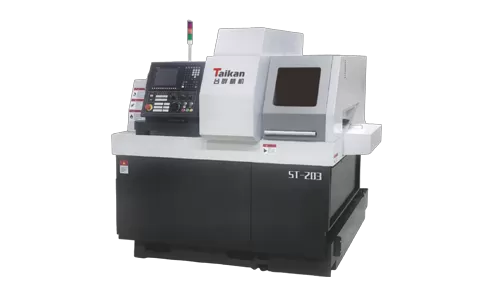
The suitable material depends on the machine and machining process. The Taikan Machine ST203 is specifically designed for stainless steel processing.
What is the Taikan Machine ST203?
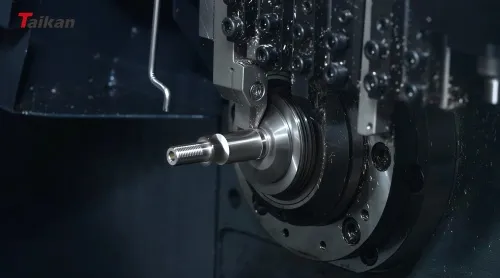
The ST203 is a Swiss-type lathe from Taikan Machine. It features a single-spindle, single-system configuration, a maximum spindle speed of 8,000 rpm, a maximum machining length of 240 mm, 3 linear feed axes, a rapid traverse speed of 32 m/min, and 5 standard driven tool holders.
Wayne Zhao
Chief Technical Expert, Taikan Machine
A CNC expert with 10+ years of experience in control systems and machining.
Formerly with Siemens and FANUC, Wayne specializes in system commissioning, 5-axis programming, and integrated machining applications. He is dedicated to transforming technical expertise into actionable industry insights.

 Español
  português
  русский
  العربية
  Türkçe
  français
  Deutsch
  italiano
  ไทย
ไทย  tiếng việt
  Polska
  Malay
Malay  हिंदी
हिंदी  Indonesia
  ಕನ್ನಡ
ಕನ್ನಡ 

 Vertical Machining Center Drilling and Milling Machining Center Profile Machining Center Horizontal Machining Center 5-Axis Machining Center Gantry Machining Center CNC Lathe CNC Swiss-Type Automatic LatheS series Standard Edition with 3-Axis Linear Guide Rails H Series Advanced Edition with 3-Axis Linear Guide Rails M Series Excellent Rigidity T-V Series Light Cutting W Series Hub Machining L Series Two Rails and One Hard Rail T Series 3-Axis Hard Rail HDT Series High Precision Vertical Machining CenterB Series Drilling & Milling Machining Center S Series Drilling & Milling Machining Center SE Series Drilling & Milling Machining CenterT Series Moving Column Type & BT30 (Tilt-Disc Tool Magazine) V Series Moving Column Type & BT40 (Tilt-Disc Tool Magazine)HT-H11 Horizontal Machining Center HHQ5 High Rigidity Horizontal Machining Center HDH-63 Horizontal Machining Center HDH-100S Horizontal Machining CenterT-U Series 5-Axis Tapping Machining Center V-U Series Vertical 5-Axis Machining Center FH Series 5-Axis Milling and Turning Machining Center CX700-2000 Seven-axis Five-simultaneous Milling And Turning Machining CenterG-V Series 3-Axis Linear Guides G-VU Series 5-Axis Gantry Machining Center G-BU Series Bridge 5-Axis Gantry Machining Center